
The Wine-Dark Tennessee
Bloom and Blood at Shiloh
This chapter is adapted from my Civil War work-in-progress, The Wine-Dark Tennessee, and appears here as part of Top in Fiction’s Spring Fever! Horror in Bloom event.
Pittsburg Landing, Tenn.
April 6, 1862 – 7:16 AM
William Tecumseh Sherman sat on a camp stool with his dark blue coat half-unbuttoned, a triangle of once-white undershirt showing on his breast. The dawn was damp with river mist. A single sheet of paper lay open across his knee, smudged from his thumb where he had held it too long.
Dearest Cump
You must not let your melancholy return. I fear it every day when I wake, that it might have claimed you in the night. Remember your children; remember me. There is a Providence in all things. Do not let the burden of the army crush the husband I love.
Ellen
He had read the lines three times, his wife’s words catching differently each time—once as a sincere prayer, once as yet another admonition, and finally as a thin tether binding him to home. He folded the paper in one hand.
His attention was arrested by a rangy little peach tree in the wood line near his tent. It was blooming. Three pink blooms, luminescent in the mist. One blossom was a failure, petals curled and dark.
Barely hanging on.
From behind him came a sound, distant; a crack, like a single twig snapping.
“Horse,” he croaked, hoping not to be heard, but the aide, Holliday, was already there with the reins.
Move, Cump. Move.
Two horses, hooves churning damp earth. Saddle leather creaking, blowing steam.
“General,” Holliday said. “Did you hear… General?”
Sherman looked up at the boy.
Not a boy, he corrected himself. Private Holliday had been a man for more than a decade, but his face was still smooth and beardless. The aide held the reins out to him.
“General?”
Sherman levered himself up from the stool and took the reins.
They rode without haste at first, Sherman ahead and the aide behind, letting the horses pick their way southward along the Corinth Road.
They passed between Shiloh Church and its hillside graveyard, weathered stones leaning at uncertain angles among the grass. Beyond that they passed the cold spring where Shiloh Branch bubbled up and ran clear over pale gravel. The horses stepped down into the shallow dip, water darkening their fetlocks before they climbed the opposite bank.
Farm fields opened on either side, furrows turned and waiting, dark soil exhaling the damp scent of renewal. Cabins stood abandoned, doors swinging loose, smokeholes cold, the inhabitants having fled ahead of the army. Parts of Sherman’s division were sprawled across these fields, tents scattered among broken rails where soldiers had fed the farmers’ fences into their fires.
The morning had the color of young leaves— a thin green light rising through mist. Budding branches leaned over the narrow track, scratching at the two soldiers as they passed.
Behind him, the camp dissolved into a haze of canvas and smoke.
“General,” Holliday said softly, urging his mount closer.
Sherman heard him but did not answer. He was thinking of a conversation a few evenings before, when Holliday had spoken with a kind of shy reverence about Tennessee in springtime — a heaven on earth, he had called it, a place where winter forgets itself. When they had first encamped near the Methodist meetinghouse called Shiloh, Holliday had smiled at the word itself— the place of peace.
Now the woods seemed determined to prove him right. Dogwoods opened like white-hot stars among the darker trunks. Redbuds flamed along the road and somewhere unseen a mockingbird poured out reckless song.
Another crack sounded in the distance.
Sherman glanced up, then away again. Firing at shadows, he told himself. Inactivity turns every snapping twig into an enemy.
They rode on.
More sounds followed— a faint ripple, like wood steps creaking underfoot. The horses lifted their heads. Holliday shifted in the saddle.
“Did you hear—”
“It’s nothing,” Sherman said, though he had not truly listened. In these springing woods and with the enemy twenty miles away, the war felt distant and unreal.
Something in the air changed. Powder smoke threaded through the sweetness of wet earth. Still Sherman rode forward, mind caught in his own thoughts.
Another sound came, louder now— not a single crack but many, overlapping, rolling toward them like distant thunder. He felt it before he understood it— a change in pressure.
Sherman raised one gloved hand. “Hold.”
The woods ahead erupted, flame bursting from brush and shadow. A line of fire opened across the low ground, flashes stuttering faster than thought. The sound struck a heartbeat later— a tearing roar that swallowed birdsong and morning together.
For an instant everything slowed. Holliday’s horse rearing, mouth opened in a silent scream. Pine needles leapt from branches; severed leaves hung suspended. Sherman saw the air itself tremble.
Then something spun him in his saddle.
Pain tore through his upheld right hand. The reins slipped. He watched his glove split, watched blood flower against the leather, bursting into bloom.
A second impact followed.
Holliday’s face was turned toward him. The Minié ball erased his face mid-breath. One moment the young aide sat upright in the saddle, mouth open to speak; the next the beardless face disappeared in a red spray.
The reins fell from nerveless fingers.
The world narrowed to fragments: a drifting peach blossom turning slowly in the air; a riderless horse plunging past; smoke sliding low through the trees like a rising fog. Time stretched thin, each movement drawn out and unreal.
He stared at the empty space where Holliday had been, unable to reconcile the silence in his own mind with the sudden violence that filled the woods. The landscape that had seemed so tender a moment before now pulsed with flashes and screams, yet part of him remained fixed on green leaves trembling in spring light.
Another volley cracked overhead.
—
When the spell broke he was already fleeing back along Corinth road toward his encampment. Pain surged in his hand, hot and blinding. Sherman forced himself upright in the saddle, breath tearing loose at last.
Soldiers boiled out of tents and from around their campfires as he passed. His horse leaped cleanly over Shiloh branch and he was back among his officers. The road behind Shiloh Church was already choked with men when Sherman forced his horse through the press.
“Forward, get that line forward!” The day was not an hour old and his voice was already gravelly. “Captain! Get this army moving.”
He felt muffled in wet wool— sound delayed, motion softened— yet his body moved without hesitation. An officer shouted that the line had broken near the camps; another pointed toward a battery abandoning its position. Sherman wheeled his horse toward the guns before the thought fully formed.
“Back to the ridge!” he called, voice cutting through the confusion. “Dress on the colors! There is no retreat here— only a change of ground.”
A regiment hesitated at the edge of a clearing, officers arguing over which way the enemy pressed. Sherman rode between them, reins held awkwardly in his uninjured hand.
“You are facing the wrong direction,” he said, calm as if correcting a drill error. “Wheel left. Form on that battery. You will fire by volleys until I tell you otherwise.”
They obeyed before doubt could return.
The Confederates surged from the timberline in ragged waves, gray coats flickering between trunks. Sherman felt the stillness settle over him— the numb clarity that swallowed fear and replaced it with motion.
He watched the line fire, reload, fire again. For a moment he saw Holliday as he had been that morning— smiling at the blooming fields— and the image struck him harder than any ball. The world tilted, threatening to slide away. Smoke engulfed the dogwoods and redbuds, turning the blossoms to pale ghosts. He forced himself upright.
A shell burst nearby, showering him with dirt. His horse shied; he leaned forward, murmuring reassurance without realizing it.
“Steady!” he shouted. “You are Union soldiers— you do not run from brush and noise!”
At last the battery limbered up, wheels grinding through the soft earth. Sherman turned south along the Corinth Road, pulling stragglers into formation as he went. Every few yards he halted fragments of regiments, turning panic into purposeful motion.
A courier galloped up, breathless. “General Grant has come up from the Landing, sir. He asks if you can hold.”
Sherman wiped sweat and powder from his eyes with his sleeve.
“Tell General Grant I will hold as long as any man stands.”
The answer felt rehearsed, yet true. He wondered briefly whether Grant believed him— whether anyone would— then pushed the thought aside as another volley slashed through the woods.
—
By midday the retreat had hardened into a stubborn line bending toward the Tennessee river and Pittsburg Landing. Sherman rode continually, ignoring the ache in his wounded hand. Twice horses had been shot from under him; this third mount trembled with exhaustion, flanks dark with sweat.
Near a shallow ravine a brigade faltered, men glancing over their shoulders at the river behind them. Sherman spurred forward, planting himself in front of the colors.
“You are not trapped against the river,” he said quietly. “It keeps them off your flanks.”
The colonel stared. “We are already flanked, General.”
Sherman shook his head. “You are alive. That is advantage enough.”
He turned his horse sideways to the enemy line. A private near the front muttered a prayer; another raised his musket with shaking hands.
“Forward ten paces,” Sherman ordered. “Kneel and fire.”
They moved.
The volley cracked cleanly, smoke surging outward and balls whipping across the top of the grass. Confederate skirmishers dropped. The brigade steadied and the retreat regained form.
A staff officer rode up with news of collapsing lines farther west. Sherman nodded understanding.
“We will not collapse. We will fall back by orderly intervals,” he said.
“Every man who sees us ride will believe the day is not yet lost.”
He felt like an actor but it steadied the men so he committed to the role— posture straight, face composed.
The final defensive position formed near the landing— artillery gathering on a ridge backed by the river while fragments of divisions converged. Sherman rode along the crest, shouting encouragement, placing regiments where the ground dipped and rose.
Gunboats on the Tennessee boomed in slow intervals like thunder, shells arcing overhead. Each explosion among the enemy steadied the men.
A group of soldiers stared at Sherman as he passed, one whispering, “That’s the mad general.”
Sherman felt like the violence around him had burned away the part of him that was able to care.
“Anchor your right on the ravine.”
“Keep your intervals— do not crowd the guns.”
“Hold your fire until you see their belts.”
The Confederate assault came in waves against the ridge, flags rising and falling in the smoke. Sherman rode behind the line, turning small breaks into renewed resistance. When a regiment faltered he rode directly into their midst, seizing a fallen color and lifting it high until cheers rose around him.
He did not remember deciding to do it.
The sun dipped toward the trees, light turning red through the haze. At last the attacks slowed, the enemy fire slackening into scattered shots. Men collapsed where they stood, too exhausted even to speak.
Sherman dismounted near a cluster of guns and looked back along the ground they had crossed— fields, woods, and broken camps fading into smoke.
Somewhere out there lay Holliday and the others— men who would never rise again.
His numbness began to crack, letting exhaustion seep in. Yet beneath it lay a fierce, quiet certainty: the army still existed. The line had not dissolved. The river lay behind them, but not as an escape— as an anchor.
For a moment he believed that the day had been wrestled back from chaos. Not won— held by stubborn will.
Somewhere beyond the trees the enemy fires flickered, answering the Union lights along the riverbank. Between them lay the silent ground of Shiloh, transformed from a place of peace into something darker— a field where men had become legends simply by refusing to yield.
Sherman turned at last, mounting once more despite the pain in his hand. There was still work to do.
—
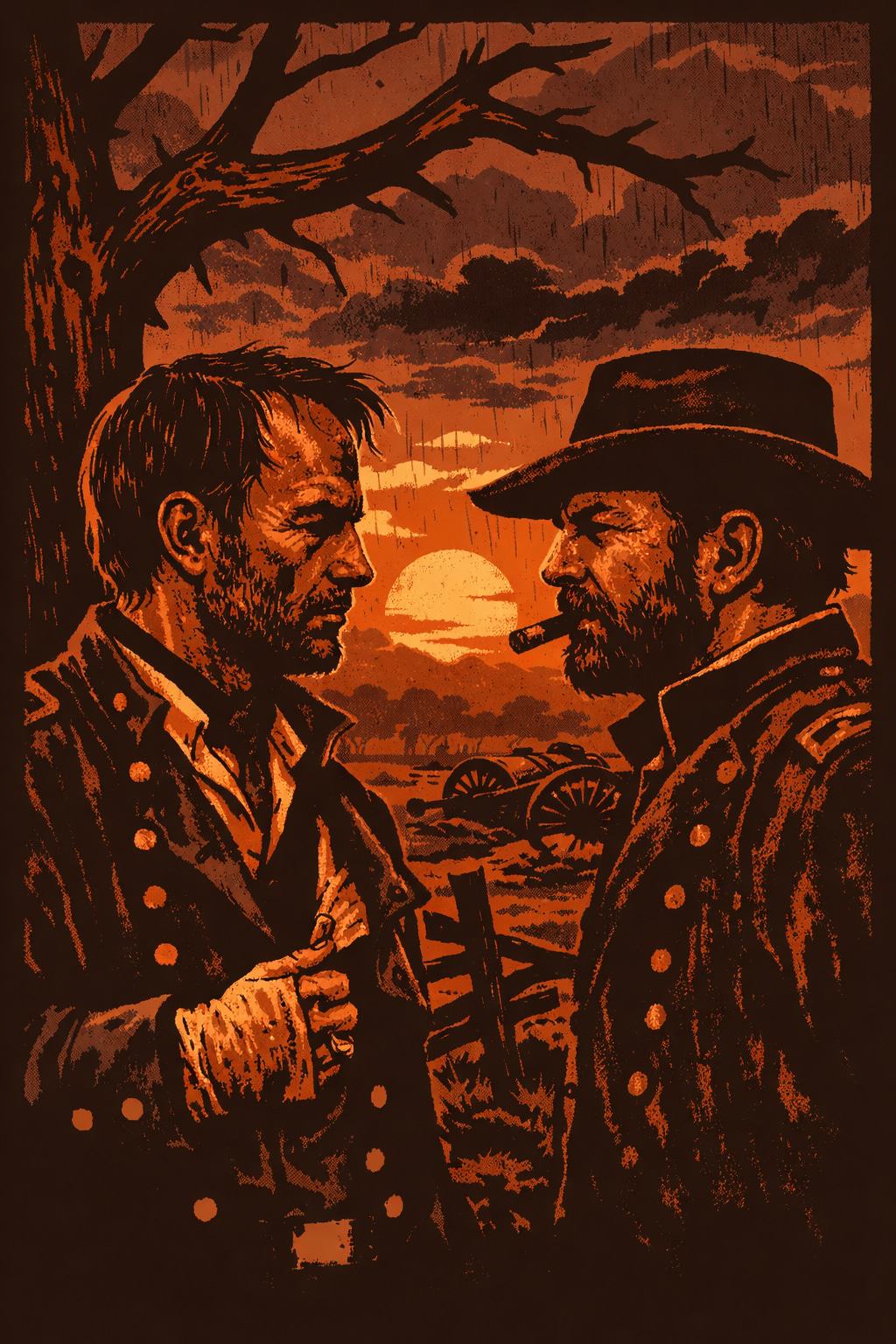
Sherman found Grant near the center of the worst of that day’s slaughter. The General stood leaning against a tree beside a sunken farm track, mud to his knees, face gray and unreadable.
Sherman dismounted and the two men faced each other, silent and appraising for a long moment. Sherman shifted from one foot to the other, felt abashed, prayed it didn’t show on his face.
Grant said nothing.
“Well, Grant,” Sherman finally rasped, his voice catching. “We’ve just had the Devil’s own day.”
Grant rolled the unlit half of a broken cigar in his mouth, drew a long breath and exhaled slowly.
“Yep.”
Sherman’s eyes searched Grant for blame.
Eventually Grant finished his thought. “But we’ll lick ’em tomorrow.”
Now Sherman searched Grant’s eyes for belief. He swallowed rather than speaking his doubt.
Grant’s gaze drifted to Sherman’s double-breasted jacket hanging open, a scrap of smudged paper sticking from the inside pocket.
Grant nodded. “Your coat.”
Sherman glanced down. He’d been running all day with it half-unbuttoned and had forgotten the letter. Ellen’s words— Dearest Cump— peeked out at him. He folded the flap over quickly, tucking her voice away.
“You’ll need that hand tended.” Grant said. “And the shoulder.”
Sherman looked down at his right hand. The flesh between his finger and thumb was torn and red. He flexed the hand slightly. He had not even realized when a Minié ball had plowed a furrow into his shoulder.
“It is a small thing, General,” said Sherman. “In light of…” He gestured at the field in front of them, but he was thinking about the baby-faced boy, Private Holliday, clinging reflexively to his horse, haloed in a mist of blood and brain.
“Still…” Grant said, and motioned toward a medical tent.
Grant remained under the tree as Sherman moved away. He looked out across the field where dead men and horses lay among overturned caissons.
Naked, bullet-pocked trees reared over a paste of crushed leaves and grass. Bruised clouds slouched across the setting sun. The only movement was the slow, stumbling steps of medics, and the buzzards circling low.
Then the first drops of rain thumped on the brim of Grant’s hat.
This story is free to read. If you value this work and would like to support future installments, consider upgrading to a paid subscription.
For $8/month, you help make projects like this possible.
There’s something unsettling about how beautiful this is.
You let the reader settle into the softness of the world… the blossoms, the mist, the quiet… just long enough that when the violence hits, it doesn’t feel shocking…
It feels inevitable.
That tension between tenderness and brutality runs the whole piece, and it makes the final moments hit even harder.